
The Geometry of Speed: How Progressive Banking Creates Multi-Groove Short Track Racing
Why Flat Bottoms and Single Grooves Nearly Broke Oval Racing
Short-track racing has always carried a built-in geometric problem. The car nearest the apron travels the shortest route around the corner, so the inside lane appears to hold an automatic advantage. On a flat or uniformly banked oval, that advantage can become overwhelming. Drivers brake hard, turn toward the bottom, and protect the narrow strip of pavement that produces the smallest lap distance. Once the field falls into line, the race can become a freight train, with each car following the same arc and waiting for a mistake rather than creating a pass.
The issue is not simply a lack of courage or aggression. It is a consequence of how radius, speed, tire grip, and corner exit interact. A uniform banking angle gives every part of the turn a similar geometric solution, while the low groove still offers less distance. A car that moves high may gain a better entry or exit, but it must usually surrender enough distance in the middle of the corner to lose time overall. Traditional oval design therefore tends to lock drivers into one dominant lane through the apex, especially when the surface is smooth and the cars are closely matched.
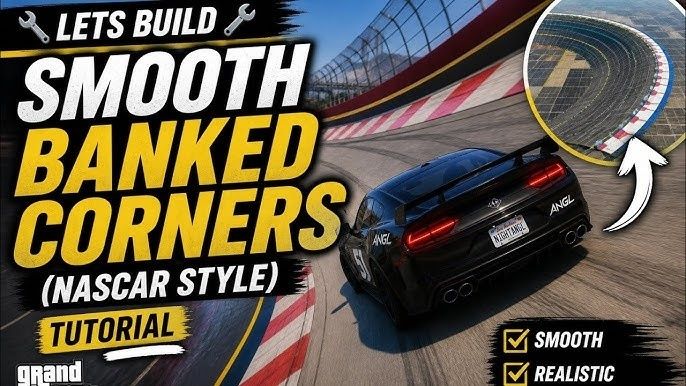
Progressive banking was developed as an intentional civil engineering answer to that problem. Instead of giving the entire racing surface one fixed tilt, the banking angle increases from the bottom toward the outside wall. At Kevin Harvick’s Kern Raceway, for example, the paved oval rises from 12 degrees at the bottom of the corners to 14 degrees at the top, with eight degrees on the straightaways, according to Kern Raceway track details. That modest change can transform the race-day equation by allowing a longer outside route to carry more speed, preserve momentum, and attack the next straight.
The Physics of the High Line vs Low Line Equation
Every cornering car must generate centripetal acceleration, which is the inward acceleration required to follow a curved path. In simplified form, that requirement is expressed as a = v²/r, where v is speed and r is corner radius. The low groove has a smaller radius, so it demands more inward acceleration at any given speed. The driver can compensate by slowing down, but slowing down creates a different penalty when the car reaches the straightaway.
The high lane has the opposite profile. It adds linear distance because the car travels closer to the perimeter, yet the larger radius reduces the centripetal demand. Progressive banking adds another advantage by redirecting a portion of the car’s load toward the racing surface. A steeper upper lane does not eliminate tire friction, but it lets the track surface contribute more of the force needed to turn the car. The result is a tradeoff rather than a simple inside-line victory.
| Racing line | Primary advantage | Primary penalty | Typical lap-time effect |
|---|---|---|---|
| Low groove | Shortest distance and strong braking reference | Smaller radius, greater speed loss, limited exit momentum | Fast when tires are fresh or traffic is heavy |
| Middle groove | Balanced radius, speed, and positioning | Requires precise throttle control | Often becomes the most consistent line during a run |
| High groove | Larger radius, greater banking, strong corner-exit speed | Longer route and greater exposure to the wall | Can equal or beat the low line as rubber and heat build |
The mathematical penalty of the outside line is therefore real, but it is not decisive by itself. A longer path can still produce a shorter elapsed time if the car maintains enough additional speed. For example, a high-line driver may spend more distance in the corner but avoid the low line’s heavy braking and early throttle limitation. If that car exits several miles per hour faster, the gain continues down the straightaway and into the next braking zone.
Track shape complicates the equation further. Research comparing large oval layouts has shown that tracks with similar headline dimensions can behave very differently because banking, shape, bumps, surface age, seams, and temperature alter the available grip. Detailed oval-track comparisons demonstrate why a nominal banking number cannot fully predict a car’s behavior. Progressive banking works best when the surface, tire compound, suspension, and car configuration allow drivers to exploit those different radii rather than forcing every car into one narrow operating window.
Turn by Turn Breakdown of Progressive Banking Dynamics
Corner entry is where the low and high lanes first separate. A low-line driver can brake later because the car is already aimed at the tightest part of the turn, but that approach creates a sharp transition from braking to rotation. The high-line driver normally enters with more speed, opens the steering angle, and allows the wider radius to absorb momentum. The low car may reach the apex first, while the high car is already carrying speed toward the center of the turn.
At mid-corner, the progressive surface becomes the critical feature. A flat upper lane would normally make the car wash out, meaning the front tires lose authority and the car drifts toward the outside. Increasing banking counters part of that tendency by supporting the chassis as lateral load rises. The driver can hold a higher speed without demanding the same slip angle from the front tires. The exact benefit depends on surface grip, tire temperature, and chassis balance, but the geometry gives the outside lane a legitimate performance foundation.
Corner exit is where the longer route can pay its dividend. A car that stays low may need to wait before applying full throttle because the rear tires are still handling a high combined load. The upper-lane car can unwind the steering sooner, use the banked ramp to stabilize the platform, and accelerate toward the straight. This is particularly important in rear-wheel-drive stock cars, where excessive throttle can overload the rear tires and produce wheelspin. A clean exit often matters more than winning the first few feet into the corner.
- Entry: The attacking car follows the lower lane and brakes later, placing its nose alongside the opponent’s rear quarter.
- Rotation: The defending car moves toward the middle while the attacking driver chooses a higher arc, preserving speed instead of forcing a sharp turn.
- Mid-corner: Progressive banking supports the outside car, allowing it to remain alongside without sliding into the wall or lifting off the throttle.
- Exit: The high-line car straightens its steering earlier and gains drive, while the low-line car reaches the straight with less momentum.
- Next approach: The passing car completes the move only if it can clear the other vehicle before the next braking point, turning lane choice into a continuing tactical exchange.
This is why modern oval racing can produce passes that develop over an entire corner rather than appearing as a single dive. The drivers are not merely choosing left or right. They are selecting a radius, a braking point, a throttle map, and a level of risk. Racing simulations that model weight transfer, tire grip, aerodynamic effects, and banking reflect the same principle: different oval tracks require different lines because their physical opportunities are different.
Chassis Setup and Tire Management on Dynamic Surfaces
Progressive banking changes the normal-force pattern across the car. In a left-hand turn, the outside tires carry more vertical load, while the banking changes how much of that load contributes to cornering rather than simply compressing the suspension. The chassis must keep the tire contact patches stable as the car moves from the flatter bottom lane to the more heavily tilted upper lane. A setup that feels neutral down low may become tight or loose when the driver climbs several feet toward the wall.
Suspension tuning is consequently a balancing act. Spring stiffness, bump rubbers, shock travel, sway-bar load, ride height, and lateral locating-bar geometry all influence how quickly the car takes a set. Circle-track setups often use soft springs with a large sway bar or bump-rubber engagement to control roll without making the car excessively stiff everywhere. As explained in this circle-track suspension guide, a bump rubber engaging at the outside front can sharply increase effective spring rate and roll stiffness, producing a more neutral balance. The window is narrow, because small changes in compression can create major changes in handling.
Tire management then decides which lane remains fastest over a full green-flag run. The high arc may reduce steering demand in the center of the corner, but it can place sustained load into the right-side tires and generate heat. The low arc can create more scrub and sharper slip angles, accelerating wear even if the path is shorter. Driver feel, stopwatch data, tire temperatures, and repeatable suspension measurements should be considered together rather than relying on a single setup impression.
- Keep toe close to neutral unless drivetrain forces or suspension deflection justify a controlled exception.
- Use rear camber carefully, because banking, tire distortion, and traffic can change the ideal contact patch.
- Place weight low and distribute it so the right-side tires gain useful load without becoming overloaded.
- Check bump-rubber engagement and shock travel when moving between banking tiers.
- Compare low, middle, and high arcs over several laps instead of judging a lane on one flying lap.
During a heat, the best adjustment may be behavioral rather than mechanical. A driver can preserve the right-front tire by entering a fraction earlier, roll more freely through the center, and use the banking on exit. If the track gains rubber, the preferred lane may migrate upward. If the surface becomes greasy from heat, the middle groove may offer the cleanest balance between grip and tire life.
Iconic Short Track Venues That Mastered Variable Camber
Kevin Harvick’s Kern Raceway provides a clear modern example of how progressive banking can be built into a paved oval. The facility opened in 2013 west of Bakersfield, California, and includes both a paved oval and a third-mile asymmetrical clay oval. Its paved corners use a 12-to-14-degree progression, while the straightaways retain eight degrees of banking. That combination gives drivers a meaningful choice without turning the track into an unrestricted wall-riding contest.
Historic flat bullrings create a different kind of challenge. Their narrow corners reward rotation, braking discipline, and mechanical grip, but once the bottom lane takes rubber, the race can become highly defensive. Modern paved layouts with wider surfaces and variable banking invite more experimentation. Intermediate speedways add another layer, because their larger corner radii, higher speeds, aerodynamic dependence, and changing surfaces can make clean air as important as the banking itself.
- Flat bullrings: Precision and short-radius rotation dominate, with passing often dependent on mistakes or superior tire conservation.
- Progressive short tracks: Multiple arcs can remain viable, especially when the upper lane develops grip.
- Intermediate ovals: Banking, aero balance, surface aging, and turbulence combine to determine whether a lane is truly usable.
For drivers, variable camber changes defensive strategy. Protecting the bottom may block the shortest route, but it can also surrender exit speed and leave the outside lane alongside. A defender must decide whether to force the challenger into a tight arc or leave enough room to prevent a crossover attack. For spectators, the key visual clue is the distance between cars at corner entry and exit. If the high car appears to lose ground in the center but closes rapidly on the straight, the geometry is working exactly as intended. Side-by-side finishes emerge because two different calculations can produce nearly identical lap times.
Take Your Seat for the Modern Era of Oval Racing
Progressive banking elevated short-track competition by turning a fixed geometric advantage into a moving balance of distance, speed, grip, and tire life. The low groove remains valuable because it is shorter and often strongest under braking. The upper groove remains dangerous but rewarding because its larger radius and steeper banking can preserve momentum. The middle lane acts as the tactical bridge, giving drivers a way to adapt as rubber, temperature, and traffic reshape the surface.
At the next green-flag run, watch the corners in sequence. Note where the leader first moves off the bottom, how quickly the outside lane reaches the throttle, and whether a following car uses a crossover move on exit. Then study the banking itself, including the transition from apron to lower groove and the rise toward the wall. That trackside observation turns a fast lap into an understandable engineering diagram, revealing why the best modern ovals are not just circles with engines in them, but carefully shaped arenas where several lines can fight for the same checkered flag.

